


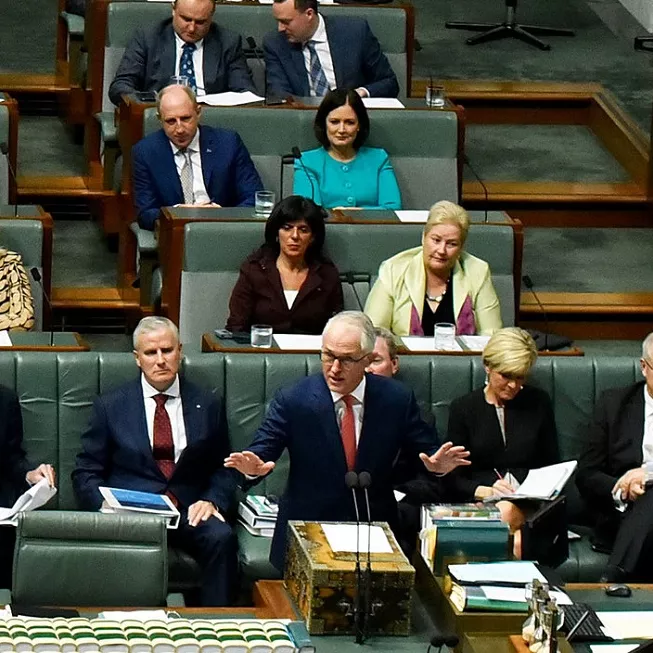

Pairing up: What is pairing in parliament?
- DateThu, 25 Aug 2016
In 2016, pairing arrangements in the newly elected parliament changed, with the Opposition becoming more stringent about granting pairs to government members.
But what exactly is pairing?
The numbers in parliament can at times be finely-balanced. This has been the case in recent years particularly. From 2010-2013, the government had no majority in the House of Representatives, and the present government has just one more seat than it needs. As a result, key votes can come down to the wire, and the absence of a single MP could mean the difference between failure and success.
When an MP is unable to attend the vote, a convention exists that an MP from the opposing side deliberately misses the vote as well, so that the numbers remain the same. This means that the government won't lose a vote through circumstances outside their control, like illness or important ministerial business. Without pairs, the government could fall because an MP catches the flu.
Pairing arrangements are entirely unofficial, and exist purely as convention. The arrangements are usually made through the whips, the members responsible for keeping track of numbers in the parliament. Because they're unofficial, they can be altered or ignored at the discretion of the members themselves, or the whips, or the party leaders. This is what happened in 2010, when the then-Opposition declared much more stringent rules for pairings, and again in 2016. No rules are being broken, and even the convention is somewhat loose. Pairing arrangements can and do get changed all the time.
MPs who are paired for a vote don't have to honour it, and in fact it is now established precedent that the Speaker has no official knowledge of any pairing arrangements. In 1925 Speaker William Watt specifically declared that pairing was up to MPs, and nothing to do with him. This tradition has continued, with the House itself the arbiter of what constitutes a fair pairing arrangement. In practice, an MP who was paired for a vote but voted anyway would probably be looked down on by colleagues and the press, but there is nothing to stop them doing so.
In previous parliaments, sometimes the prime minister was automatically paired with the leader of the Opposition, or another MP from one side always paired with another. This probably saved the whips some time, and exceptions were made if there was an issue an MP particularly wanted to vote on.
The process of voting in parliament is steeped in formality, and members are physically locked in the chamber and unable to leave once a vote begins. This obviously causes some problems for members who are paired, which is why they can be granted an exception and allowed to leave if they aren't supposed to vote.
The pairs system is potentially open to all kinds of problems because it exists solely as a matter of convention. On one occasion, a member has forgotten he was paired, and turned up to vote anyway. Another time, there were allegations the pair book, in which the arrangements are recorded, had been tampered with after the vote. In modern times, the most controversy over pairing is when oppositions, or governments, refuse to grant it, often in situations when pairs have been granted in the past.
You may also be interested in...
Red, white and blue: the Australian flag
Debate about the Australian flag has a long history.
The early life of Henry Parkes
How young Henry Parkes chose his path in life.
What is a redistribution?
Why the Australian Electoral Commission has to reassess electorate boundaries.
Australia’s entry into the Second World War
How Australia prepared for the Second World War.

Seven prime ministers who migrated to Australia
Political participation does not require being born in Australia.
Prime Minister Harold Holt's 692 days as leader of Australia
How Harold Holt's time as Prime Minister served Australia.
